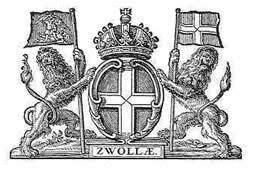


Zwolle was the first city in our country where a departure handstamp came into use: ZWOL with the city arms. It was used bij the Postmaster of the Hague Post Office.
Korteweg type 30, PEP 7330-03/04.
By measuring the handstamps on the recorded letters, the author came to the conclusion that the two existing types can be distinguished as follows: In the first type the crown is 5 mm wide (use known between 1705-1736) and at the second 8 mm (use known between 1789-1795).

Registered letter from Zwolle to Utrecht, April 1789. In Zwolle it was marked with the handstamp ZWOL with the city arms between the W and the O. Earliest recorded type 2. Registration is indicated by the crosswise applied stripes. The sender paid the registration fee. Rate to pay by the addressee: 3 stuivers, indicated on front. The letter is not dated, but due to its contents about the death of Professor Tijdeman's wife and the authors archive research in Utrecht, the date could be determined fairly accurately.

Letter from Dalen near Coevorden to Amsterdam, 29 May 1795. On the back a C is written in red chalk for Coevorden. In accordance with the postal contract of 1762, the letter went to Amsterdam via Zwolle and Utrecht. In Zwolle with the handstamp ZWOL with city arms between the W and the O. This letter is with the last known date of use of this handstamp. Postage to be paid by the addressee: 2 stuivers for the Coevorden-Zwolle ride (indicated as I I and crossed out in Amsterdam) and 3 stuivers for Zwolle-Amsterdam, a total of 5 stuivers, indicated on the front.
The eight letters known to the autor with this handstamp, of which two in public collections:
Type 1, PEP type 7330-03, 14 x 4 x 8 mm:
31-10-1705 from Leeuwarden to The Hague (National Archive, collection Museum for Communication)
25-09-1720 from Zwolle to Haarlem (ex collection Adema)
13-06-1722 from Groningen to Amersfoort (Municipality archive Amersfoort)
06-03-1736 from Blokzijl to Amsterdam (Van Dieten 1995, ex collection Eijgenraam)
Type 2, PEP type 7330-04, 13 x 3 x 8 mm:
....-04-1789 from Zwolle to Utrecht (GvW)
23-07-1794 from Coevorden to Amsterdam (van Dieten 1997 and 1999, ex colection Sir John Naborro; Corinphila NL 2019, ex collectie Wiersma)
....-....-1794 from Zwolle to Amsterdam (van Dieten 2001, ex collection Dreikurs and Wolff de Beer)
29-05-1795 from Dalen to Utrecht (ex collection Adema; GvW)

The second handstamp of Zwolle, ZWOLL without E, was in use between 1796 and 1798. The spelling Zwoll can be found in French instructions from that time.
Korteweg type 31, PEP 7330-05.

Letter from Emmelekamp (now Emlichheim) in the county of Bentheim to Amsterdam, 16 February 1798. Postage paid to Coevorden by the sender (written "Franco Coevorden" on the front). In Zwolle with handstamp ZWOLL. Postage to be paid by the addressee: 2 stuiver to Zwolle (indicated as I I and crossed out in Amsterdam) and 3 stuivers to Amsterdam, in total 5 stuivers, indicated in red chalk.
The first nationally issued name handstamp
On 1 August 1809, a name handstamp was introduced for the Post Offices in the context of the tract with France, to be used for mail to France. These stamps were made by the French company Masson in Paris. Zwolle got one where the Z was reversed. After the introduction of the departmental stamp on 1 April 1811, this name stamp could no longer be used. After the departure of the French, several places replaced the departmental stamp with this old name handstamp, but Zwolle did not, in connection with the wrong Z they cut the department number of the stamp here (see below).
The Z is not widely used in France. It is thought that the French stamp cutter has therefore reversed the letter. He also did that with the handstamp of Zutphen.
There is only one letter recorded with the handtamp ZWOLLE, a letter from l'Armée du Brabant in Zwolle to Orthez, France of 18 October 1810, which is now in the National Archive in the collection of the Museum for Communication in The Hague (ex collection DW de Haan, NPV 1985, van Dieten 1979, shown in De Postzak 204, February 2008, page 513, photo see below). There would be a second copy, but I never saw it (recorded by Dr. Carroll Chase).
Korteweg type 19 (Zwolle unrecorded by Korteweg), PEP 7330-06.


Letter from Zwolle to Orthez, Basses Pyrénees, France, 18 October 1810 with Masson handstamp ZWOLLE with inverse Z. and C.H.2e R. (Correspondance Hollandaise du 2e Rayon). Tariff: Zwolle - Breda, 20 to 35 hrs: 5 penny = 5 décimes + Antwerp - Orthez, 900-1000 km measured in bird's eye view: 11 décimes = 16 décimes, paid by the addressee.
(Only known example, collection Museum voor Communicatie).
During French domination
In the winter of 1794-1795, under the leadership of General Jean-Charles Pichecru, the French army crossed the northern territory of the Republic of the United Netherlands over the frozen great rivers. 25.000 French troops had to be stationed in the Netherlands by the peace treaty of 16 May 1795. Eventually, there were 200.000. The headquarters of the Armée du Nord and the staff quarters of the three divisions came in Gorinchem, The Hague, Middelburg and Zwolle. |
Departmental handstamps
From 1 April 1811, during the incorporation of the Netherlands at the French Empire, handstamps with a departmental number were introduced. The handstamp 120 / ZWOLLE, with the department number of the 120th department "Bouches de l 'Issel" (estuary of the river IJssel), measures 35.5 x 12 mm. and is in use between 1811 and 1813.
Korteweg type 21, PEP 7330-07, 35,5 x 12 mm.

Letter from Zwolle to Laer near Osnabrück, Germany, 28 April 1812 with handstamp 120 / ZWOLLE. Followed route: Zwolle - Deventer - Arnhem - Emmerich - Osnabrück. Postage payable by the addressee, for a distance of 200 to 300 km, weight 6-8 grams: 6 décimes.
Letters of which the postage had already been paid by the sender, which was not usual at that time, received a stamp P.120 P. / ZWOLLE. P.P. meant Port Payé, postage paid.
Korteweg type 22, PEP 7330-08, 36 x 11 mm.

Letter from Zwolle to Paris, France, 25 March 1812. The sender has paid the postage. Handstamp P.120 P. / ZWOLLE. Two diagonal lines to indicate prepaid postage. In Paris, the framed PS PS handstamp was applied: Port payé jusqu'à Paris & pour Paris (postage paid to and for Paris). Rate: 500 to 600 km, up to 6 grams: 8 décimes = 8 stuivers, indicated on reverse.

Letter from Hardenberg to Zwolle, 18 September 1813 with handstamp P.120.P / ZWOLLE. P.P. means port payé, postage paid. Also written "Franco" and two diagonal lines on the front, indicating that the postage had already been paid by the sender.
Letters that had been sent to the wrong office of destination, were rated to high, prepaid but incorrectly addressed or addressed to a person unknown to the postal administration were provided with a déboursé stamp DÉB. 120 / ZWOLLE. Déboursé means written off. This stamp was also used until 1836 after the departure of the French, until 1828 in black, then applied in red until 1835.
Korteweg type 24, PEP 7330-09, 36 x 10,5 mm.


Letter from Abbeville, northern France to Staphorst, 16 November 1812. On the front the handstamp 76 / ABBEVILLE and top left the weight indication "8". Postage for a distance of 400 to 500 km, third weight class 8 to 10 grams: 11 décimes or 11 stuivers. However, the postage was lowered to 7 stuivers, apparently the letter weighed less, just under 6 grams. On reverse, "8" was written first, but after that it was deleted and changed to "7" (the postage fot a letter weighing 6 to 8 grams was 8 stuivers and to 6 grams 7 stuivers). Due to the depreciated amount of postage, the déboursé stamp DÉB.120 / ZWOLLE was applied.
After the restoration of independence
| On Friday, November 12, 1813, a Russian Cossack corps arrived in Zwolle to drive the French away. The gates are opened in the evening. The Russians camp is in the meadow opposite De Hanekamp inn. On 23 November, the Cossacks, with the assistance of 18 Zwolle gunmen, crossed the IJssel and the French fled there. Prince Nerotschin, colonel of the Guard of the Emperor of Russia, resides in the Hof van Holland inn. There, a parade is given for him by the Korps Cossacks with choirs (Zwolse Courant 1813). |
After the restoration of independence, the department number 120 was removed from the postmark, leaving a name handstamp ZWOLLE, the so-called cut handstamp. Recorded 1813-1823.
Korteweg type 21 z/n, PEP 7330-07zn, 35,5 x 5 mm.

Letter from Blokzijl to Zwolle, 27 November 1813 with a cut handstamp ZWOLLE. With this imprint, a week after the departure of the French from Zwolle, traces of the removed department number can still be seen (so-called cut handstamp). Postage to be paid by the addressee for a letter up to 6 grams over a distance of up to 50 km: 2 stuivers, indicated on front. The French postal rates were not replaced until 1 February 1815.
From 1814 to 1829 a straight line handstamp ZWOLLE came into use, partly together with the cut handstamp stamp above. Recorded 1814-1829.
Korteweg type, PEP 7330-10, 36 x 6 mm.

Letter from Zwolle to Amsterdam with straight line handstamp ZWOLLE. Postage to be paid by the addressee for a letter up to 16 wigtjes over a distance of 20-35 hour's walk: 25 cent, indicated on front.
From 1829 round circular datestamps without the year were used with the month in letters. These were applied in red. An abbreviated name of the month had a period after it.
Korteweg type 29, PEP 7330-11, Ø 28 mm. Two datestamps issued to Post Office Zwolle on 24 March 1829. Recorded 1829-1837.

Letter from Zwolle to Bordeaux, 25 October 1829 with datestamp ZWOLLE Ø 28 mm in red. Also L.P.B.4.R. (Lettres des Pays-Bas du 4me Rayon: Zwolle was for the determination of the postage situated in the 4th district in relation to the French border ). Framed Border Post Office handstamp PAYS-BAS / PAR / VALENCIENNES in red. Rate: from the 4th rayon to Border Post Office Bergen (Mons), 0 - 7½ grams: 8 décimes + Valenciennes - Bordeaux, distance 600 to 750 km: 10 décimes = 18 décimes.
Korteweg type 29, PEP 7330-12, Ø 27 mm. Two datestamps issued to Post Office Zwolle, on 24 January 1837 and 21 February 1837 respectively. Recorded 1837-1840. In this type, the month is very low.

Letter from Zwolle to Elburg, 24 July 1837 met circular datestamp ZWOLLE 24 / JULIJ / *, Ø 27 mm in red. Rate up to 6 hour's walk, up to 16 wigtjes: 10 cent.
From 1841 the datestamp is still without the year, but the month indication is now in numbers. Recorded 1841-1850.
Korteweg type 42, PEP 7330-19, Ø 23 mm.
(In the supplement to PEP part 1, image 16, which refers to this datestamp type, is incorrectly depicted; the month should be in numbers; this has been corrected in the supplement on the Po&Po website).

Letter from Zwolle to Schiedam, 20 May 1842 with circular datestamp ZWOLLE 21/5 / *, Ø 23 mm in red. Rate for a distance between 20 and 35 hour's walk, up to 16 wigtjes: 25 cent.
This datestamp type exists also with smaller letters, recorded from about 1847.
Korteweg type 42, PEP 7330-19.

Letter from Zwolle to Amsterdam, 14 May 1849 with circular datestamp ZWOLLE 14/5 / *, Ø 23 mm in red. Rate for a distance between 20 and 35 hour's walk, up to 16 wigtjes: 25 cent.
Franco sent letters (of which the postage was paid by the sender) were also provided with a handstamp P.P. (= Port Payé = postage paid). This handstamp was made by Masson in Paris and was already provided in 1809. After independence recorded in 1816-1814 in combination with the cut handstamp.
Korteweg type 20, PEP 7330-14, 7½ mm (in combination with PEP 7330-07).

Letter to Zwolle, 26 December 1814. Cut handstamp ZWOLLE and P.P. (Port Payé = postage paid) in black. "Franco" is indicated on lower left. Two diagonal intersecting lines have also been applied as a sign of prepaid postage.
In 1815 this stamp was replaced by a two-line ZWOLLE / FRANCO. The A has a forked crossbar. This stamp was in black until 1829, without a date stamp. Recorded 1815-1829.
Korteweg type 30 Av, PEP 7330-15Av, without datestamp.

Letter from Zwolle to to the secretary of the Company of Benevolence in Frederiksoord near Steenwijk, who had a colony for impoverished families, sent 21 Septenber 1828. Handstamp ZWOLLE / FRANCO in black. Postage paid by the sender, indicated on reverse: 10 cents.
From 1829 onwards the two-line handstamp FRANCO / ZWOLLE was applied in red next to a datestamp in the same colour. Recorded 1829-1835.
Korteweg type 30 Av, PEP 7330-15 Av (A with forked crossbar) in combination with datestamp PEP 7330-11 or 12, both in red.

Letter from Zwolle to The Hague, 20 September 1834 with circular datestamp ZWOLLE / 20 / SEPT. / * in red and two-line handstamp ZWOLLE / FRANCO in red. Rate between 20 and 35 hour's walk, up to 16 wigtjes: 25 cents, indicated on reverse.
Between 1835 and 1838 a handstamp FRANCO applied in red was used. In 1835 without datestamp, from 1835-1844 with datestamp.
Korteweg type 33, PEP 7330-16, 26 x 4 mm of PEP 7330-17, 27 x 5 mm, eventually in combination with datestamp PEP 7330-11 or 12.

Letter from Zwolle to Dalfsen, 29 August 1837 with circular datestamp ZWOLLE / 29 / AUG. / *, Ø 27 mm in red and handstamp FRANCO in red. The sender paid 10 cents postage, indicated on reverse.
Between 1844 and 1850, a franco semi-circular datestamp came into use for franked letters. Now the official only had to apply one handstamp. First a small type, usually applied in blue.
Korteweg type 55, PEP 7330-18.

Letter from Zwolle via Post Office Enschede (datestamp on reverse) to distribution office Haaksbergen, 27 October 1847 with franco semi-circular datestamp ZWOLLE / 27/10/ FRANCO in blue. Postage paid by the sender, rate for a distance between 6 and 12 hour's walk, up to 16 wigtjes: 15 cents, indicated on reverse.
This datestamp is sometimes applied in black ink. Unrecorded in PEP.

Letter from Zwolle to Staphorst, 16 January 1843 with semi-circular datestamp ZWOLLE / 16/1 / FRANCO in black. Postage paid by the sender, rate within the ressort: 5 cents, indicated on reverse. Staphorst, however, was not part of the Post Office Zwolle but Meppel's jurisdiction. Not corrected, probably because the letter has never been to Meppel because Staphorst was on the postal route Zwolle - Meppel.
From 1854 there is also a year in the circular datestamp. The handstamp and the letters and numbers are larger and sans serif. There are two types with ZWOLLE in large letters: with 26 and with 24 mm diameter. On 15 February 1859, a type with smaller letters ZWOLLE was sent to this Post Office.
Korteweg type 45, PEP 7330-20, diameter 26 mm.

Letter from Zwolle to Den Haag, 10 October 1856 with circular datestamp ZWOLLE 10/10/1856, Ø 26 mm in red. Letter rate above 30 km distance, up to 15 wigtjes: 10 cent.
Korteweg type 45, PEP 7330-20, diameter 24 mm.

Letter from Zwolle to Den Haag, 23 May 1855 with circular datestamp ZWOLLE 23/5/1855, Ø 24 mm in red. Letter rate above 100 km distance, up to 15 wigtjes: 15 cent.
In 1860 a datestamp with the hour characters 4-12, 12-5 or 5-9 was issued as a trial to a number of Post Offices. The datestamp Zwolle had a diameter of 25 mm. Recorded 1861-1866.
Korteweg type 47, PEP 7330-21.

Registered letter from Zwolle to Groningen, 10 June 1862 with circular trial datestamp ZWOLLE / 10/6 / 12-5 / 62, Ø 25 mm in red and framed regisistration handstamp AANGETEEKEND in red. Letter rate to be paid by the addressee: 10 cent, indicated on front. Registration fee from 1-1-1846: 10 cent, paid by the sender, indicated on reverse.
On 22 October 1864 a small type of datestamp, diameter 20 mm, was provided to the Post Office Zwolle as a trial. Used hour characters: 4-12, 12-5 and 5-9. Recorded 1864-1868.
Korteweg type 49, PEP 7330-22, Ø 20 mm.

Letter from Zwolle to Amsterdam, 18-9-1865 met trial datestamp ZWOLLE / 18/9 / 12-5 / 65, Ø 20 mm in red. Letter rate to be paid by the addressee: 10 cent, indicated on front.
1 November 1867 a two-letter datestamp was issued to the Post Office Zwolle. In the lower part are the hour characters 12M - 8M, 8M - 12M, 12M - 4A, 4A - 8A or 8A - 12M. A = afternoon or evening, M = from midnight to 12 AM.
Korteweg type 53a, PEP 7330-23, recorded in red and black.

Letter from Zwolle to Amsterdam, 29 September 1869. Two-letter datestamp ZWOLLE / SEP 29 .. / 8A - 12M, applied in red. Postage payable by the addressee 10 cents, noted on the obverse.
Special feature of this copy: the annual figures are missing.

Small envelope from Zwolle to Avereest, 28-1-1870. two-letter datestamp ZWOLLE / 28 JAN 70 / 4A - 8A, applied in black. Postage payable by the addressee 10 cents, noted on the obverse.
A so-called pseudo-twig datestamp from Zwolle is recorded, dated 6 May 1873 *). This is the franco-twig datestamp (see below) in which the lower portion with the word FRANCO has been unscrewed and the cancel was thus used as a regular datestamp. Recognizable by the twig in the lower part. Two examples recorded, 14 March 1873 (GvW) and 6 May 1873.
PEP 7330-24.
*) Source: The Pseudo-takje stempels, De Postzak 192, A.P. de Goede.


Reconstruction pseudo-twig datestamp with removed FRANCO.

Pseudo-twig datestamp 14 / MRT / 73 = 14 March 1873
on 1 cent 1869 printed matter stamp.
In 1852 a franco semi-circular datestamp, for Zwolle with a year included, was used for the cancellation of the first postage stamps introduced in 1852. The first type has a classic Roman font style with serifs called in Dutch Egyptisch. This handstamp also exists without a year, that type was used in the first years, but not in Zwolle.
Korteweg type 56, PEP 7330-25.

Letter from Zwolle to Kampen, 3 August 1852. The 5 cent postage stamp cancelled with franco semi-circular datestamp ZWOLLE / 2/8/1852 / FRANCO in a classic font style with serifs. Letter rate up to 30 km, up to 15 wigtjes: 5 cent.
From 1854 the franco semi-circular datestamp has a sans-serif font style called in Dutch Grotesk. Recorded 1854-1863.
Korteweg type 57, PEP 7330-26.

Letter from Den Ham via Post Office Zwolle to Amsterdam, 11 January 1859. The 10 cent postage stamp cancelled with franco semi-circular datestamp ZWOLLE / 11.1.1859 / FRANCO with sans-serif font style. On reverse the straight line handstamp of sub post office DEN HAM. Letter rate above 30 km, up to 15 wigtjes: 10 cent.
In 1864, a small type semi-circular datestamp was also issued to Zwolle, width 18 mm, for prepaid mail items. This trial datestamp is exclusively provided to Zwolle. Recorded 1864-1867.
Korteweg type 57 with foodnote 5, PEP 7330-27.

Printed matter sent from Zwolle to Woerden, 14 October 1865 with small type semi-circular datestamp ZWOLLE, 18 mm wide. The sender paid the postage for 1/8th sheet. The rate for printed matter was from 1-9-1850 to 1-1-1871: ½ cent for each quarter sheet (a sheet of no more than 8 dm²).
From 1861 postage stamps were cancelled with a framed FRANCO handstamp. A datestamp also had to be applied on the letter, but not to cancel the adhesives.
Korteweg type 58, PEP 7330-28.

Letter from Zwolle to Antwerp, Belgium, 22 October 1866. Trial circular datestamp ZWOLLE / 22/10 / 4-12 / 66, Ø 20 mm in red. Rate to Belgium, 0 - 15 wigtjes: 10 cents. The stamps are cancelled with a framed FRANCO handstamp.
For the cancellation of stamps on prepaid printed matter, a franco twig datestamp (with a twig at the bottom) was issued to Post Office Zwolle on 3 March 1867. The handstamp did not meet the requirements and a new copy was sent on 1 November 1867, 'To replace one sent as unusable'. Another new franco twig datestamp was sent on 21 December 1868.
Korteweg type 59, PEP 7330-29.

Circular sent from Zwolle to Genemuiden, 28 April 1875. The 1 cent printed matter stamp issue 1869 is cancelled with franco twig datestamp ZWOLLE / 28 APR 75 / FRANCO. Rate for printed matter from 1-1-1871 to 1-8-1876, 20 to 400 grams: 1 cent.
From 1 April 1869, the postage stamps had to be cancelled with a dot or number handstamp (official name at the time: nommerstempel). Zwolle received number 135. The handstamp was sent to Post Office Zwolle on 24 March 1869 and a second one on 15 December 1871.
Korteweg type 60, PEP 7330-30.

Letter from Zwolle to Antwerp, Belgium, 6 September 1869. The 10 cent stamp 1867 issue is cancelled with dot cancel 135. Two-letter cancel ZWOLLE / 6 SEP 69 / 8M - 12M. Rate to Belgium, 0 - 15 wigtjes: 10 cents.
For the later handstamps see the publication by Cees Janssen on the website of the Nederlandse Academie voor Filatelie: Inventarisatie poststempels.
Last update 14.01.2026 10:47 AM
Copyright © 2019 -
G.L. van Welie FRPSL
Secretary of the Nederlandse Academie voor Filatelie
Representative of the Royal Philatelic Society London for the Netherlands
Nothing from this website may be copied, distributed and / or published without written permission from the author.
Additions or remarks?